
States of Matter and Particle Models
Explain phase, pressure, and particle motion.
Solids, Liquids, and Gases
Objective: Compare particle arrangement and macroscopic shape and volume.
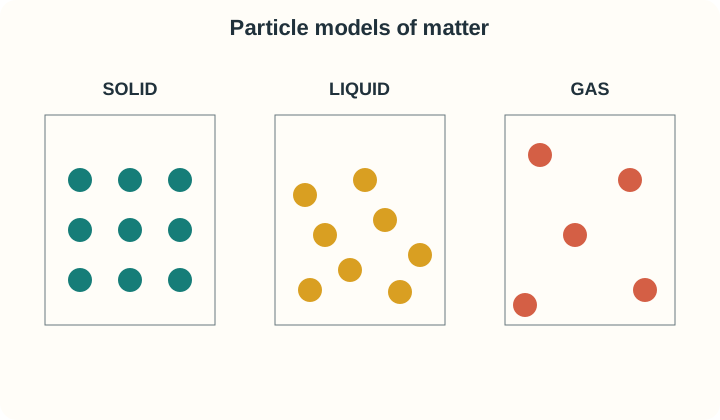
In a solid, particles remain near relatively fixed positions while vibrating or otherwise moving microscopically; a crystalline solid has organized structure, while amorphous solids differ. Liquids flow and take a container’s shape while maintaining approximately fixed volume over modest pressure ranges. Gases spread to fill available volume and are readily compressed because particles are widely separated relative to their sizes. These are models with exceptions and ranges, not claims that solid particles never move or liquids are perfectly incompressible. Plasma is an ionized state found in many high-energy contexts. Macroscopic state depends on temperature, pressure, composition, and intermolecular interactions.
Worked examples
Try itWhich state ordinarily fills the entire available container volume?Show answer
Gas. Gas particles spread through available space.
Swipe sideways to move between sections
You finished the reading!
Lock it in with a few practice questions, then move on to the next lesson.