
Fission, Fusion, and Energy
Explain nuclear energy pathways and constraints.
Mass Defect and Binding Energy
Objective: Describe energy conservation in nuclear transformations.
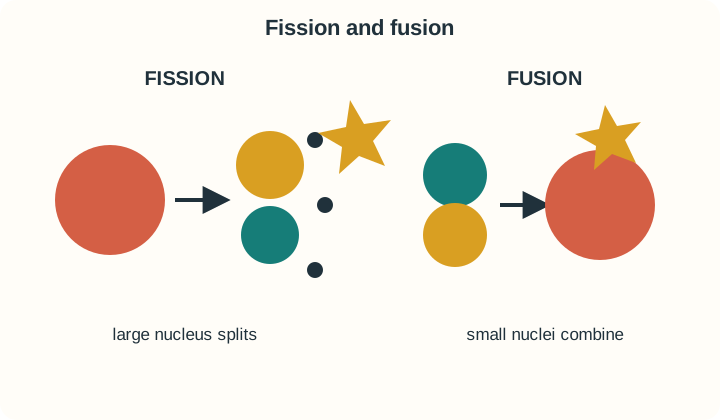
Nuclear binding energy is the energy required to separate a bound nucleus into constituent nucleons in a defined model. A bound nucleus has lower rest mass than those separated particles; the mass difference corresponds to binding energy through E = mc². When a nuclear reaction yields products with greater total binding energy per the relevant bookkeeping, some energy appears in kinetic energy, photons, or other forms. Calculate a mass-energy conversion only with consistent SI units: 0.001 kg corresponds to 9 × 10¹³ J using c ≈ 3 × 10⁸ m/s. No mass-energy is created from nothing; total energy and applicable conserved quantities are accounted for in system plus surroundings.
Worked examples
Try itWhat is c in E = mc²?Show answer
Speed of light in vacuum. c is a universal speed constant.
Swipe sideways to move between sections
You finished the reading!
Lock it in with a few practice questions, then move on to the next lesson.