
Acids, Bases, and pH
Use aqueous acid base models and pH safely.
Acids and Bases in Water
Objective: Distinguish common definitions and strengths.
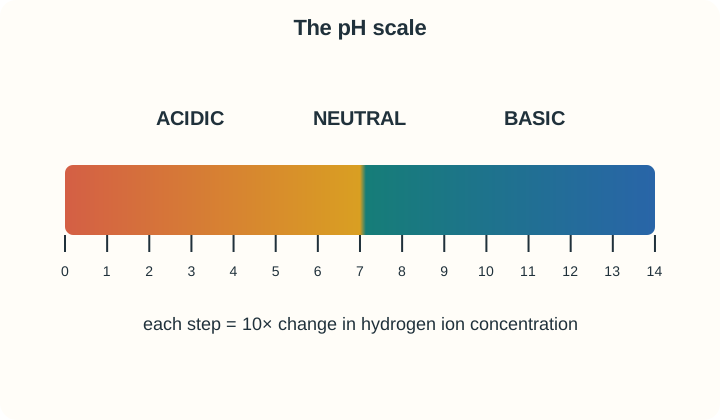
In the Brønsted–Lowry model an acid donates a proton and a base accepts a proton. In familiar aqueous systems, acidic solutions have higher hydronium concentration than neutral water at the same temperature, while basic solutions have higher hydroxide concentration. The Arrhenius model describes acids as increasing H₃O⁺ and bases as increasing OH⁻ in water, with a narrower scope. Acid strength describes extent of ionization under defined conditions, whereas concentration describes amount per volume; a dilute strong acid and a concentrated weak acid are possible. Household labels do not by themselves establish pH or safety. Introductory examples include HCl as a strong acid in water and acetic acid as a weak acid in water.
Worked examples
Try itIn the Brønsted–Lowry model, what does an acid do?Show answer
Donates a proton. A proton donor is an acid.
Swipe sideways to move between sections
You finished the reading!
Lock it in with a few practice questions, then move on to the next lesson.